

Cyber security assessment and the signals your business needs one
QUICK SUMMARY
Core verdict: A cyber security assessment turns assumption into evidence. The businesses reading the signals early are the ones who stay in control of what happens next.
Key insight: The trigger rarely comes from nowhere. It's a regulation change, a client or insurer question, or a sector tightening its own standards.
Actionable step: Check where your business stands against a recognised baseline like the ASD Essential Eight, before an outsider forces the question.
QUICK NAVIGATION
- What does a cyber security assessment for my business involve?
- What steps are included in my cyber security assessment
- How long will my cyber security assessment take?
- How do I know if my business needs a cyber security assessment?
- What signs suggest it's time for me to get a cyber security assessment?
- How Do I Choose the Right Partner to Run My Assessment?
- What happens after my cyber security assessment is complete?
- What will my assessment report include?
- What should I do with the findings from my cyber security assessment?
- What to do now
New anti-money laundering rules landed on 1 July 2026, but they didn't stop at money laundering. Real estate, accounting and legal firms that relied on the three million dollar Privacy Act exemption are finding it no longer applies to how they handle client data.
That's just one signal.
Your indicator might look nothing like that. But a client asking how you protect their data, an insurer adding a new question to the renewal form, a board member asking what's in place and getting nothing solid back, could be yours.
Whatever they look like to you, the question underneath is the same. Do you know your data is protected, or are you just assuming it?
A cyber security assessment is one of the best ways you find out, and here's what that involves, and how to know if it's time for you to take pre-emptive action.
What does a cyber security assessment for my business involve?
A cyber security assessment reviews your systems, finds where the gaps sit, and measures them against a recognised standard like the ASD Essential Eight or SMB 1001.
Two things are worth knowing before you agree to one. What happens during it, and what it takes from your week.
What steps are included in my cyber security assessment?
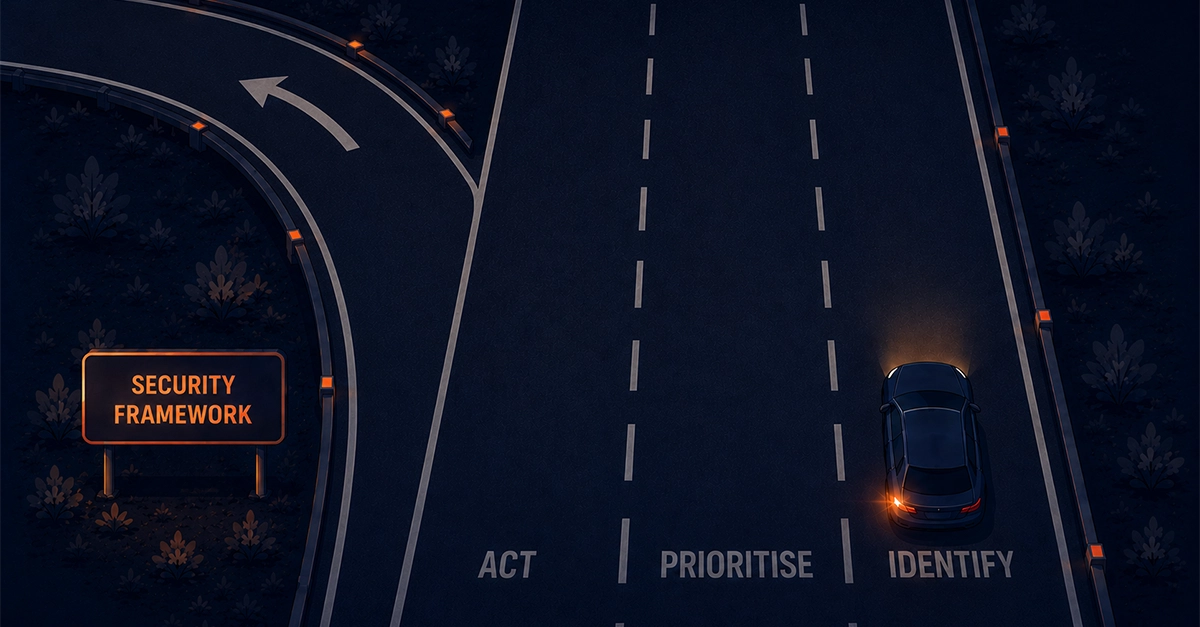
It identifies where the risks sit, prioritises what matters most, and sets out what to act on, in that order.
If your business doesn't have dedicated security staff, this can sound bigger than it is. But a good assessor handles this without disrupting your day-to-day, and hands you a clear picture of where you stand. The report at the end is the first real signal of where you stand, not where you assumed you did.
How long will my cyber security assessment take?
Timing depends on size and complexity. A smaller business with a handful of systems can be done within a week, but more locations and software add time. A good provider tells you this upfront, not halfway through.
Scope that wasn't agreed upfront is what blows out a timeline. A vague answer here is a signal in itself.
How do I know if my business needs a cyber security assessment?
You need one if a client, insurer or regulator has asked for proof, your industry has come under new obligations, or you've never had one done.
Knowing what an assessment involves is one thing. Knowing whether your business needs one is the real question. These are the signals you should be looking out for.
What signs suggest it's time for me to get a cyber security assessment?
The signs split into two types, external pressure from clients or insurers, and internal pressure from your board.
The first is external pressure. A client running due diligence before signing a contract. An insurer adding a new question to the renewal form. New regulation pulling your industry into scope, the way this year's AML/CTF reforms did for real estate, accounting and legal firms. A sector tightening its own standards.
The second is internal. A board member asking what's in place and not getting a clear answer. This one rarely comes with a deadline, which is exactly why it gets missed. But it's the one that often gets you caught out.
Or simply never having had one done. That's not a smaller risk than the others, it's a bigger unknown.
If a breach happens, APP 11 asks whether you took reasonable steps to protect that information. Without an assessment on record, you have no evidence to point to.
None of these signals mean you're at fault, they mean the ground has shifted, worth checking where you stand against a baseline. That's exactly what cyber security consulting helps you work out.
A note if you're in healthcare
The RACGP recently revised its Computer and Information Security Standards, the framework general practices are assessed against for accreditation. Patient data comes with obligations other sectors don't carry, and that bar just moved higher. Advanta and ADITS clients in this space are already ahead of that signal. Plenty of the industry isn't.
How Do I Choose the Right Partner to Run My Assessment?
Look for relevant experience with businesses your size, a plain explanation of how they work, and a report you can read. If they can't explain it in a sentence or two, that's a signal too.
A technical report with no context is close to useless. You need to know what was found, what matters most, and what to do about it. That's the difference between a report that sits in your inbox and one that changes how you run your business. Our guide, Cyber Security Consulting for SMEs walks through this in more depth.

What happens after my cyber security assessment is complete?
You get a prioritised report and a plan for what to fix first. The assessment itself is step one. What happens next is what matters.
What will my assessment report include?
A useful report ranks the risks by what matters most and sets out practical next steps, not just a list of findings. It's the clearest signal you'll get out of the whole process, don't let it get buried in technical detail.
Prioritised means the thinking's already been done for you, you shouldn't be left holding twenty flagged issues with no sense of which matters first. The Australian Cyber Security Centre's small business guidance is a useful reference point to check your provider's recommendations against an independent source.
What should I do with the findings from my cyber security assessment?
Findings should turn into an action plan, technical fixes, policy updates, or cyber security training for your team, ideally with support to implement it.
A gap analysis only earns its cost if it leads somewhere. Ask your provider what support looks like once the report lands.
What to do now
Every signal in this piece points to the same place. A law change, a client's question, a board member who can't get a clear answer, a decade of never having checked, none of them are the same event, but they all ask you the same question, do you know where your business stands, or are you assuming it.
Reading a signal early doesn't require certainty. It just means acting on what you can already see, before the timing gets decided for you. That's the real difference between a business that gets asked to prove itself under pressure and one that's already got the answer ready.
Businesses that read the signal early get to choose their next move. Those that wait for a client, insurer or regulator to ask first don't get that luxury.
If you're ready to see where your business stands, our Cyber Security Assessment service is the place to start.
More Articles



Stay up to date
Subscribe to our newsletter for IT news, case studies and promotions