

AI Advisory in Australia, the Case for Slowing Down First
QUICK SUMMARY
Core verdict: Choosing an AI tool is the fast decision, working out who's accountable for it is the slow one.
Key insight: The technology decision is quick. The governance decision, who's accountable, what data it touches, what happens if it's wrong, takes longer.
Actionable step: Before you look at a single tool, name the actual problem you're solving and who's accountable if it gets something wrong. If you can't answer both, you're not ready to buy yet, you're ready to ask.
QUICK NAVIGATION
I see this pattern often with professional services firms. A practice principal trials a chatbot because two competitors already have, keen not to be left behind. But he and his practice manager had never agreed who'd check the output before a client saw it.
That's exactly what this fear of falling behind breeds, jumping in before you've planned who's accountable. He hadn't sent a flawed contract yet. But skip that accountability step in your own practice, and one day you're the one sending a client a contract with the wrong settlement date.
What does an AI advisory service do for my business?
An AI advisory service reviews where AI fits your business, works through the privacy and governance implications, and confirms who's accountable before anything goes live, independent of whichever tool you end up buying.
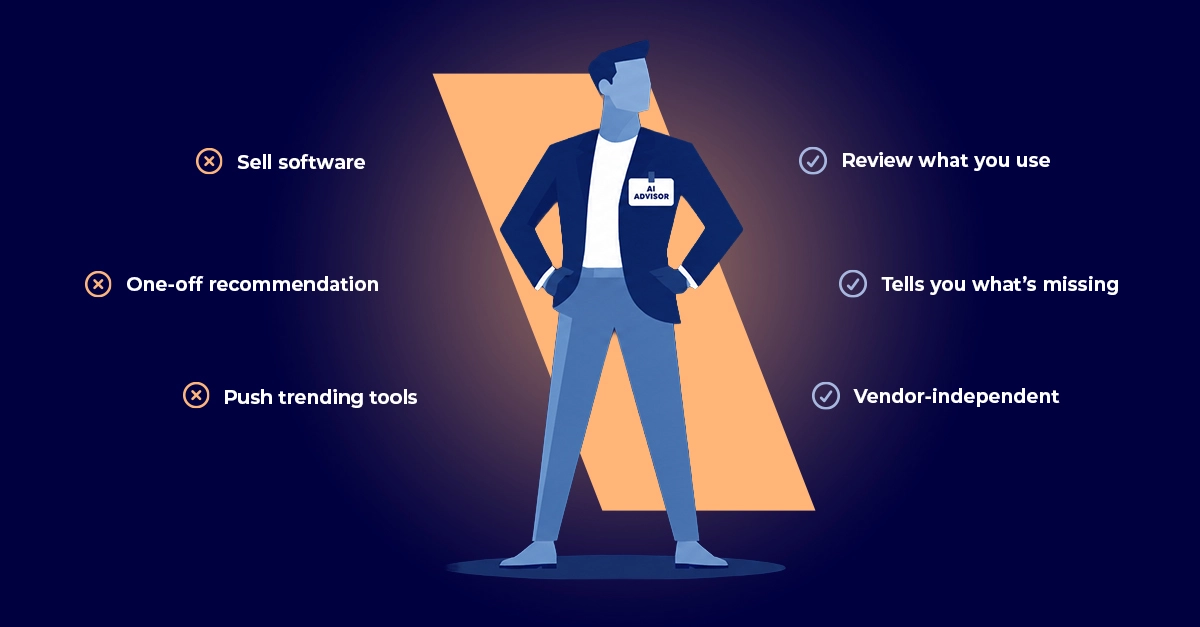
Here's the confusion. People assume an AI advisor is just an IT consultant with a new pitch, selling whatever tool is trending. It's not. An advisor doesn't recommend software. They tell you what needs to be in place before you use it, independent of any vendor.
What an AI advisory service involves
- Assessing where AI genuinely fits your operations, not where it's fashionable
- Running an AI Readiness Assessment to determine the maturity of your tenancy before adoption
- Reviewing privacy and governance implications before any tool goes live
- Setting decision rights, so everyone knows who signed off on what
- Advising independently of any software vendor
You can see how Advanta approaches this on the AI advisory services page, alongside the wider governance and cyber work underneath it.
Do I need an AI advisor if my team's already using ChatGPT?
Casual use isn't governed use, so yes, even if someone's already using ChatGPT or Copilot day to day, you still need to decide what they're allowed to put into it before that becomes a problem.
You're probably not starting from zero. Your staff are likely already drafting emails or summarising documents with a chatbot. That's not the issue. The issue is what's being typed into it.
A policy naming which AI tools are approved gives you control over what can be accessed, and that matters more the moment your business holds personal or commercially sensitive information.
I see this pattern often with regional not-for-profits, where a fundraising coordinator pastes donor details into a chatbot to draft thank-you letters faster. A manager doesn’t know it’s happening. No policy says it can’t. That's a privacy breach, waiting for a donor to ask where their details ended up.
If you take the time to decide now, you close the gap before it costs you anything.
How do I know if my business is ready for AI advisory?
You're ready when you can name the problem you're solving, not just the tool you're considering, and when you or your operations lead is willing to slow the process down long enough to check it first.
Readiness isn't about your tech stack. It's about whether you or your operations lead are ready to check the tool's output. Miss that, and you're just pushing the inevitable mistakes onto your client. That’s the difference between being ahead and just moving fast with no idea where you’re going.
Questions worth asking before you get started
- Do we understand what data this would touch
- Who's accountable if the AI gets a client's details wrong
- Are we solving a real problem, or reacting to what a competitor is doing
- Have we costed the governance work, not just the software
What does working with an AI advisor look like for me?
It starts with a short, straightforward assessment, moves into one specific use case rather than a full rollout, and ends with a decision to proceed with clear guardrails, or to hold off.
What this looks like in practice
In my experience, this starts with a business wanting to automate one manual process, like a bookkeeping firm using AI to pull figures off scanned receipts instead of a junior doing it by hand. The first meeting isn't about the technology. It's about what data the process touches, whether those receipts ever contain a client's bank details, and who checks the output before it's filed. Once that's mapped, the technology decision can be made. The governance decision is what takes longer, and it rightfully should.
If data privacy concerns are part of what's holding you back, that's worth working through properly rather than assuming it rules the idea out. Privacy Pulse is where I'd point you first.
What to do now
None of this needs to move quickly, and that's exactly why it works. Rushing the tool decision doesn't buy you time, it just moves the cost to later. The businesses getting this right aren't the fastest movers. They're the ones who assessed the situation before they spent anything. If that's where you are, it's worth having that conversation before you spend a dollar on software.
More Articles



Stay up to date
Subscribe to our newsletter for IT news, case studies and promotions