

Your business continuity plan is due a reality check
Your business continuity plan was thorough when it was written. When was that, exactly? Three years ago? Four?
The person who wrote it has now moved on, and the systems it covers look nothing like what you use today.
I bet it’s sitting in your shared drive doing exactly the one thing a continuity plan should never do.
Nothing. A crisis won’t be as polite.
Business continuity planning isn’t a documentation exercise. It’s a risk management one. If you have a plan and you’re quietly unsure whether it would hold up. This article is for you.
What are the key risk areas my business continuity plan needs to address?
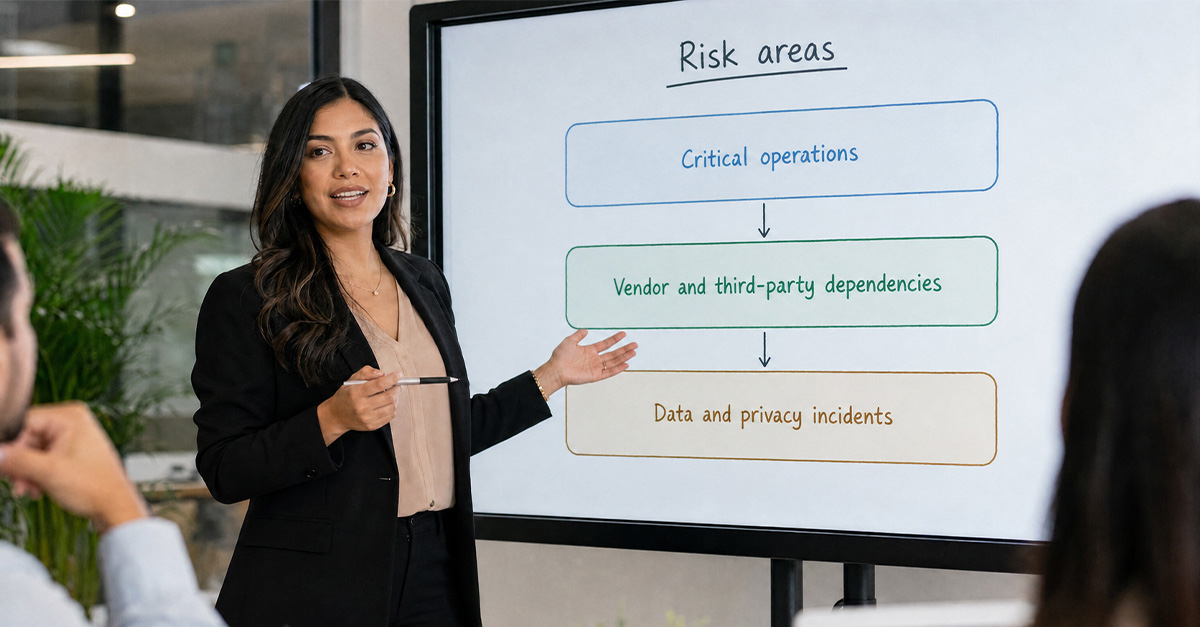
A genuine business continuity plan doesn’t try to plan for everything. It plans for the right things. That means mapping the disruptions likely to affect your actual operations, not the dramatic, worst-case scenarios that make good TV.
Here are the risk areas where I see the biggest gaps.
Is my business continuity plan built around my actual critical operations?
Probably not. A continuity plan built on assumptions about critical operations rather than mapped ones will have gaps you won’t even see until something goes wrong.
Your plan should reflect what keeps your business running. The bones that keep your team working and your business afloat.
I worked with a regional medical practice that had mapped its critical operations around its appointment system. Reasonable enough on paper.
But when a power outage took the building offline, the bigger problem was not rescheduling patients.
Nobody knew where the physical clinical notes were stored or who had authority to contact the after-hours provider. The plan covered the system, but it completely missed the people and processes around it.
What you think is essential and what keeps it functioning are sometimes two different things. You don’t find that out by reading the plan. You find out by walking through the steps of an actual crisis.
Does my continuity planning account for third-party and vendor risks?
If you haven’t mapped your vendor dependencies, it doesn’t. Your continuity plan needs to account for what happens to your operations when a vendor, platform, or supplier fails, not just what happens internally.
Your continuity plan most likely covers what happens inside your organisation. But your business also depends on a web of third parties to deliver your services. Cloud platforms, payroll software, case management systems, and specialist contractors. If any of those go offline, your operations will stall regardless of how well your internal plan was written.
You don’t have control over your vendors recovery times, and your clients won't care whose at when you're running with half the lights off.
A Business Continuity Plan maps those dependencies before they become a crisis. It tells you which vendors carry real operational risk and what your exposure looks like if they fail.
How does a data or privacy incident affect my business continuity?
A data or privacy incident triggers operational, regulatory, and reputational consequences all at the same time. If your continuity plan doesn’t account for that scenario, your response will be reactive rather than managed.
When a breach occurs, your operations don’t pause politely, hands folded, while you manage the response.
You will be frantically notifying affected clients, notifying the OAIC, minimising reputational fallout, answering staff questions, briefing your board, updating your website, all while desperately trying to keep the business running.
The continuity plans I review rarely account for that scenario.
If you’re not sure how mature your current privacy posture is, the Privacy Pulse health check is a free tool built around the OAIC’s own framework. It takes minutes and gives you a clear picture of where your privacy maturity sits.
How do I know if my business continuity management is working?
You test it. A continuity plan that has never been run against a real or simulated scenario hasn’t been tested. Documentation isn’t the same as readiness.
Think of a fire drill. Every building is required to have an evacuation procedure on the wall. Half of your staff wouldn’t be able to tell you what was on it, but the procedure exists.
Whether it would function under real pressure is a different question entirely.
The same gap shows up in business continuity management all the time. The plan was written when your business had fewer staff, one office and a different IT setup. Since then, there are new staff, new systems, new vendors and maybe a new location. Your plan hasn’t kept up.
Four valuable questions to ask yourself:
- When was the plan last reviewed against how the business actually operates today?
- Has it ever been tested against a real or simulated scenario?
- Do the people named in it still work here and know their role?
- Does it account for your current vendor dependencies and data handling obligations?
Honest responses that had you holding your breath tells you exactly where to start.
One distinction worth naming clearly. A business continuity plan and a disaster plan are related, but not the same thing.
Your disaster recovery plan covers how you restore specific systems and data after an incident. Your business continuity plan covers how the whole organisation keeps operating during and after a disruption. Both are necessary, but treating them as the same document isn’t the way to go.

What does a risk-based approach to business continuity actually look like?
It starts with identifying what would stop your business from operating, not what sounds like a risk on paper. From there, you build response procedures around those specific scenarios rather than trying to cover every conceivable event.
It’s about identifying your highest-impact risks and making sure the plan directly addresses them. That means the plan reflects your actual business, not a theoretical version of it.
Where do I start when building a risk-based business continuity plan?
Start with your two most likely disruptions and map what you would do in the first two hours. That single exercise will surface more gaps than any template or documentation review.
For an Australian SME, that means a cyber incident, a key person going offline unexpectedly, a critical vendor outage, or a natural event affecting access to your systems.
Pick the two most relevant to your business. Write down who is responsible, what they do first, and who they call.
Where you can't answer those questions confidently is where your plan needs work. That exercise costs an hour. Finding out your plan doesn’t work in a real crisis costs considerably more.
The Australian Government provides a useful starting framework for small business continuity planning. For organisations that want a structured, risk-led guidance rather than a template, that’s the work I do at Advanta Advisory.
What to do now with your business continuity plan
Start with the exercise above. Pick two disruptions, map the first two hours and write down who does what. That’s your starting point.
If what you find raises bigger questions about your risk exposure, vendor dependencies, or how a privacy incident would affect your operations, that’s exactly the kind of work Advanta Advisory does with leadership teams.
Explore Advanta Advisory’s risk and governance services to understand what a structured, risk-based approach looks like for your organisation.
Frequently asked questions
How often should my business continuity plan be reviewed?
Does my small business need a business continuity plan?
Who is responsible for business continuity planning in a small business?
Do I need a consultant to help with my business continuity plan?
More Articles



Stay up to date
Subscribe to our newsletter for IT news, case studies and promotions